
We Tested 24 Car Battery Testers Over the Past 3 Weeks to Find the Most Reliable Option of 2026.
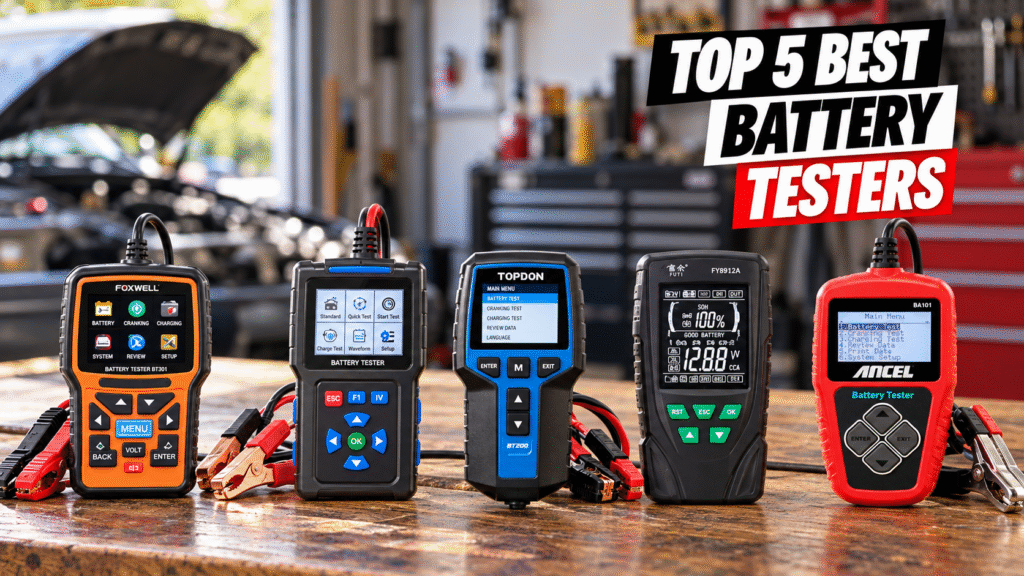
A reliable car battery tester can help you spot a weakening battery before it leaves you stranded, check charging-system performance, and diagnose starting problems without immediately visiting a mechanic. Many testers promise fast, accurate results, but finding one that consistently delivers dependable readings, supports multiple battery types, and remains easy to use can be surprisingly difficult.
We tested 24 car battery testers, including models from TOPDON, FOXWELL, ANCEL, KONNWEI, and MOTOPOWER. The top 5 were evaluated based on the following criteria:
Testing Accuracy
A battery tester is only useful if its readings are dependable. We compared voltage, CCA, state of health, and state of charge results to determine which models provided the most consistent battery assessments.
Battery Compatibility
Vehicles use several different battery technologies and voltage systems. We evaluated which testers support the widest range of 6V, 12V, and 24V batteries, along with common battery types such as flooded, AGM, GEL, EFB, and lithium.
Cranking & Charging Tests
A good tester should do more than simply measure battery voltage. We tested each model’s ability to evaluate starting performance, cranking voltage, and alternator charging-system health.
Display & Ease of Use
Clear results are especially important for users who are not professional mechanics. We compared screen visibility, menu navigation, testing speed, cable quality, and how easy each tester was to operate.
Features & Reporting
More advanced testers can provide detailed diagnostic information beyond a simple pass-or-fail result. We evaluated features such as SOH/SOC analysis, CCA testing, waveform monitoring, stored test history, and shareable diagnostic reports.
After three weeks of testing, we present the five best car battery testers that truly live up to expectations.

With 22 years of experience in automotive technology, Robert knows what separates a reliable battery tester from an inaccurate one. In this review, he tested several models to find the most dependable options for checking battery health, starting performance, and charging systems.

OVERALL ANALYSIS
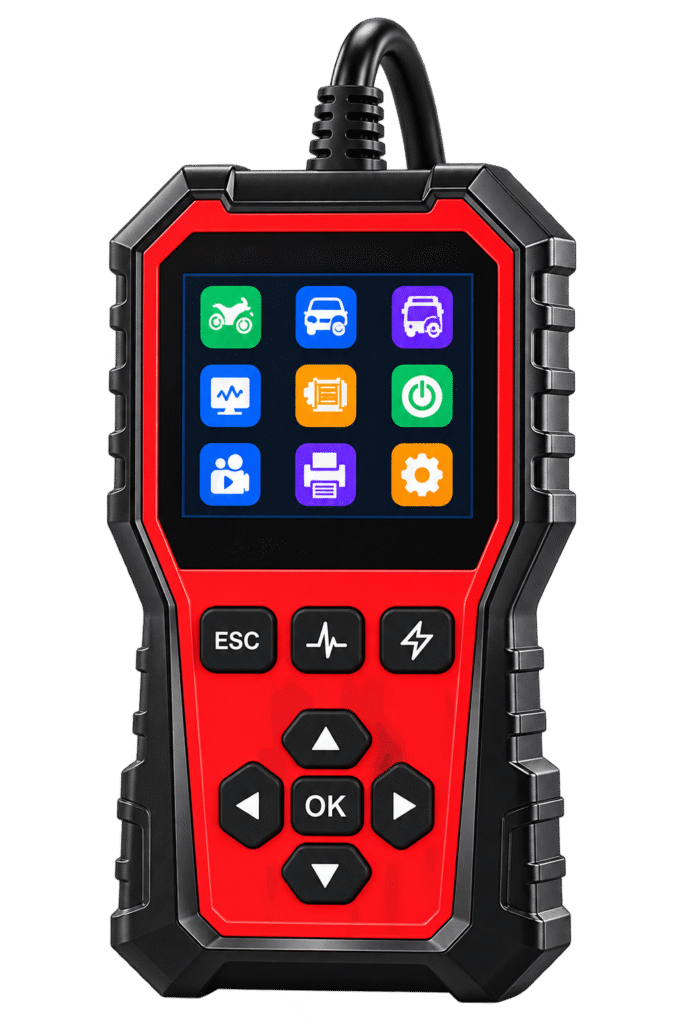
Ampora Car Battery Tester is by far our favorite choice on the market.
The first thing that makes it stand out is its broad 6V, 12V, and 24V battery compatibility, making it suitable for everything from motorcycles and everyday cars to larger vehicles. Instead of needing separate testers for different vehicles, Ampora gives you a much more versatile diagnostic tool in one compact unit.
What really impressed us, though, is the amount of information it can provide. Ampora measures key battery data including State of Health (SOH), State of Charge (SOC), voltage, and Cold Cranking Amps (CCA), helping you understand whether a battery is healthy, beginning to weaken, or approaching replacement.
It also performs dedicated cranking and charging-system tests.
This means you can go beyond simply checking the battery itself. Ampora can help evaluate how well the battery performs when starting the engine and whether the vehicle’s charging system is operating correctly, making it much more useful when diagnosing starting or electrical problems.
One of our favorite features is the real-time voltage waveform display. Rather than relying entirely on a single numerical reading, you can monitor voltage behavior visually, giving you another useful way to identify irregularities in the electrical system.
Battery compatibility is another area where Ampora performs particularly well. It supports several commonly used battery technologies, including flooded, AGM, EFB, GEL, and lithium batteries, giving it considerably more versatility than basic voltage testers.
Ampora also includes test-history storage and QR-code diagnostic reports. Once you’ve completed a test, results can be reviewed later or turned into a convenient QR report, which is especially useful when keeping records or sharing battery information with someone else.
Another major advantage is how straightforward it is to operate.
The tester features a clear 2.8-inch color display with an intuitive menu system, making detailed battery information much easier to understand. It also supports 12 languages, which adds to its usability for a wider range of drivers and technicians.
There is also no separate battery or charging routine required for the tester itself. Ampora draws the power it needs directly from the connected vehicle battery, so it’s ready whenever you need to perform a test.
Overall, Ampora combines detailed battery-health analysis, 6V/12V/24V compatibility, cranking and charging diagnostics, multiple battery-type support, waveform monitoring, and convenient reporting in one easy-to-use device. For drivers who want to identify battery problems before they turn into unexpected starting failures, it’s easily one of our top choices.
Pros
- Supports 6V, 12V, and 24V batteries
- Measures State of Health (SOH)
- Measures State of Charge (SOC)
- Provides Cold Cranking Amps (CCA) analysis
- Performs dedicated cranking-system tests
- Checks vehicle charging-system performance
- Supports flooded, AGM, EFB, GEL, and lithium batteries
- Features real-time voltage waveform monitoring
- Clear 2.8-inch color display
- Generates convenient QR-code test reports
- Stores previous test history for later review
- Powers directly from the connected battery, so no separate charging is required
Cons
- Often out of stock due to high demand
- Only available through the official website
CONCLUSION
Ampora Car Battery Tester is reasonably priced for a premium diagnostic tool packed with practical features, including 6V/12V/24V testing, SOH and SOC analysis, CCA measurement, cranking tests, charging-system checks, and real-time voltage monitoring. Take advantage of the limited-time discount while supplies last.
Ampora also offers a money-back guarantee and free shipping, giving you extra peace of mind when ordering.
With its combination of accurate battery diagnostics, broad battery compatibility, detailed system testing, easy-to-read results, and convenient reporting features, Ampora was our clear choice for the best car battery tester of 2026.
2. TOPDON BT200
OVERALL ANALYSIS
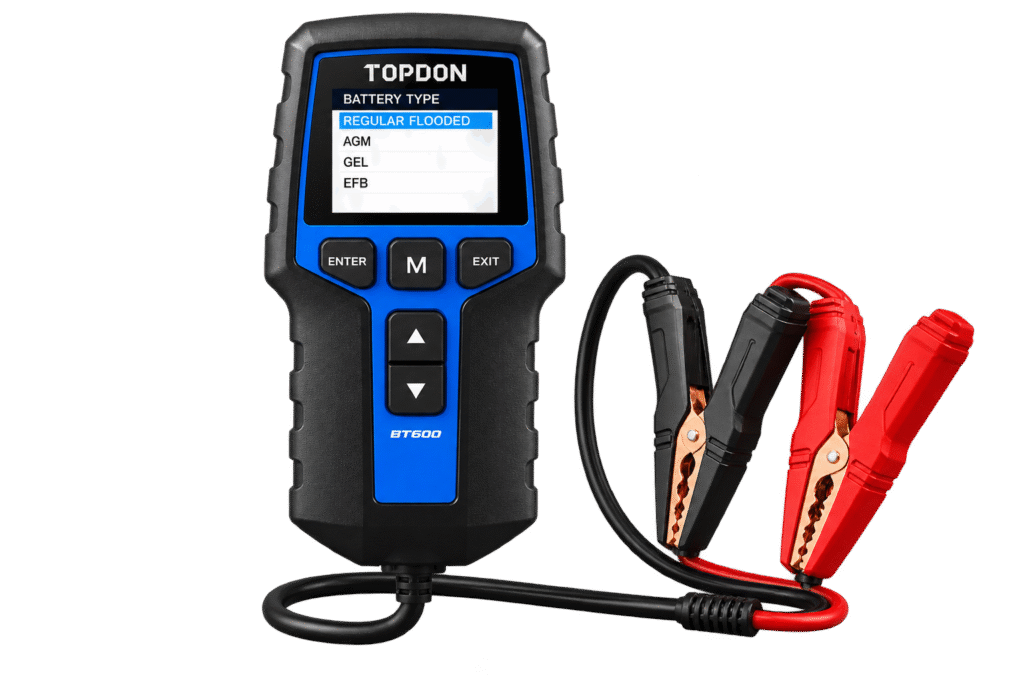
The TOPDON BT200 is a well-rounded battery analyzer designed for drivers and DIY mechanics who want more information than a basic voltmeter can provide. It performs battery-health, cranking, and charging-system tests, giving you useful measurements such as State of Health, State of Charge, voltage, and Cold Cranking Amps.
Its 2.4-inch color display makes the results easy to read, while support for regular flooded, AGM, GEL, EFB, and VRLA batteries gives it solid compatibility across many common vehicle applications. Cranking tests can show voltage drop and starting duration, while charging tests help determine whether the alternator is supplying appropriate voltage.
The main limitation is that its dedicated battery-health analysis is primarily intended for 12V lead-acid batteries, even though it can perform cranking and charging checks on 24V systems. It also lacks some of the more advanced reporting and battery-type versatility found on Ampora. Overall, the BT200 is a dependable diagnostic tool with a straightforward interface and a strong range of core testing functions.
Pros
- Tests battery health, cranking, and charging performance
- Supports 12V battery testing and 12V/24V system diagnostics
- Measures SOH, SOC, voltage, and CCA
- Bright 2.4-inch color LCD
- Compatible with flooded, AGM, GEL, EFB, and VRLA lead-acid batteries
Cons
- Does not support lithium battery testing
- No QR-code report generation
3. FOXWELL BT705
OVERALL ANALYSIS
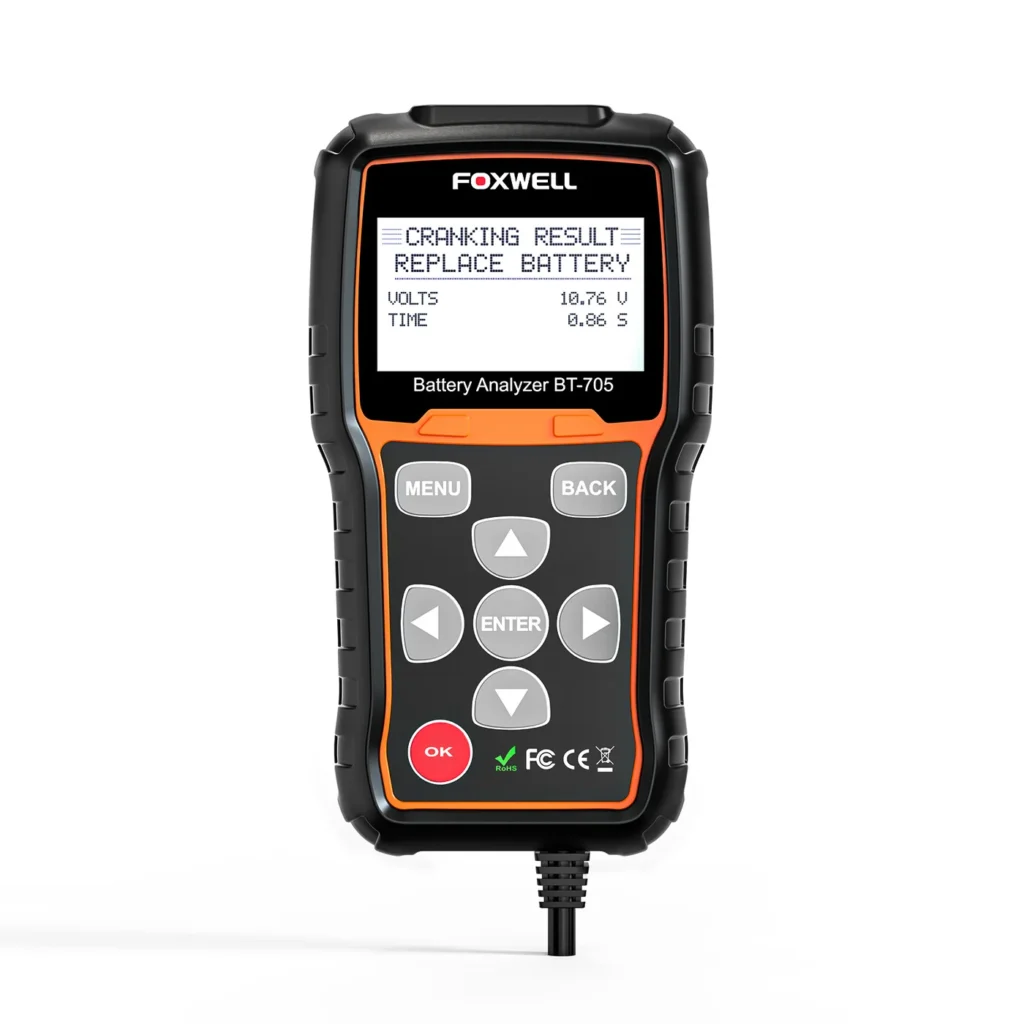
The FOXWELL BT705 is aimed at users who need a more heavy-duty battery tester capable of working with both passenger vehicles and larger 24V applications. It supports batteries rated between 100 and 2000 CCA and can work with several common standards including CCA, CA, MCA, JIS, DIN, IEC, EN, and SAE.
Battery diagnostics include State of Health, State of Charge, available power, CCA, and voltage, while separate cranking and charging tests help assess starter performance and alternator output. Its compatibility with flooded, AGM flat-plate, AGM spiral, and GEL batteries also makes it useful across a broad selection of conventional automotive batteries.
Its drawbacks are mainly related to convenience. The BT705 only retains the latest test result, so it is less useful for anyone who wants to compare multiple readings over time. It also lacks modern features such as QR-based reports and lithium support. Still, for users who value straightforward 12V and 24V lead-acid diagnostics, the BT705 remains a capable alternative.a
Pros
- Supports 12V and 24V battery systems
- Wide 100–2000 CCA testing range
- Measures SOH, SOC, CCA, and voltage
- Performs cranking and alternator tests
- Supports several international battery-rating standards
Cons
- No lithium battery support
- Screen and interface feel more traditional
- Only keeps the most recent test result
4.ANCEL BA301
OVERALL ANALYSIS
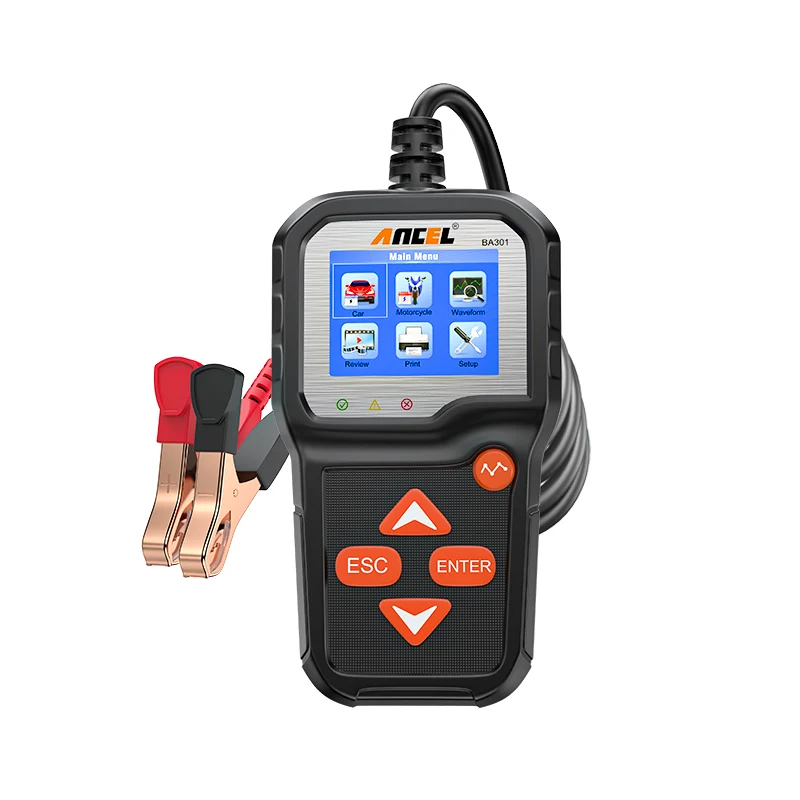
The ANCEL BA301 stands out mainly because of its support for both 6V and 12V lead-acid batteries, making it useful for motorcycles, cars, ATVs, boats, lawn equipment, and other smaller vehicles. It can test batteries between 100 and 2000 CCA and supports common standards including CCA, BCI, CA, MCA, JIS, DIN, and SAE.
Along with checking battery health and cold-cranking capability, the BA301 can diagnose the starting and charging systems, helping identify whether an issue is being caused by the battery, starter, or alternator. Compatibility with regular flooded, AGM flat-plate, AGM spiral, GEL, and EFB batteries gives it good coverage of conventional lead-acid technologies.
The biggest compromise is the lack of 24V support, which limits its usefulness for larger vehicles. It also doesn’t provide features such as waveform monitoring, lithium compatibility, or QR-based reporting. For basic and intermediate diagnostics on 6V and 12V systems, however, the BA301 provides a useful balance of compatibility and functionality.
Pros
- Supports both 6V and 12V batteries
- Wide 100–2000 CCA range
- Performs battery, cranking, and charging-system tests
- Supports numerous battery-rating standards
Cons
- No 24V battery support
- No lithium battery testing
- Smaller and more basic interface
5. Schumacher BT-100
OVERALL ANALYSIS
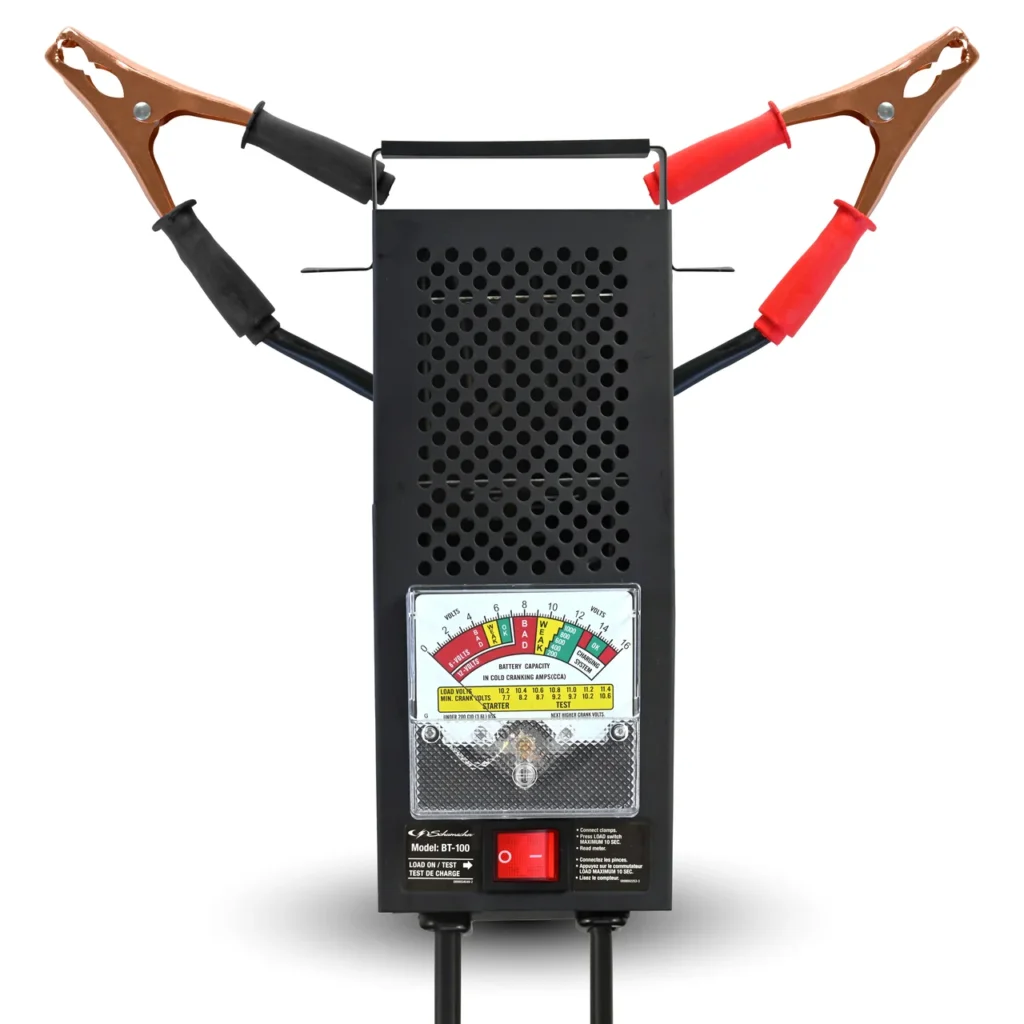
The Schumacher BT-100 takes a very different approach from the digital analyzers in this list. Rather than relying primarily on electronic conductance testing, it performs a traditional 50-amp load test on 6V batteries and a 100-amp load test on 12V batteries, providing a direct way to evaluate battery performance under load.
It can also test the vehicle’s charging system and starter motor draw, making it useful for identifying common starting and electrical problems. The heavy-duty steel housing, insulated carrying handle, and substantial clamps give it a more workshop-oriented design than many compact handheld analyzers.
The trade-off is technology. Results are displayed through an analog meter, and there is no SOH percentage, SOC reading, test-history storage, waveform display, or digital reporting system. That makes the BT-100 less convenient for users who want detailed diagnostic data at a glance. However, for someone who prefers traditional load testing and rugged mechanical simplicity, it remains a practical diagnostic tool
Pros
- Supports 6V and 12V batteries
- Performs true 50A/100A load testing
- Tests battery condition and charging systems
Cons
- Uses an analog meter instead of a digital display
- No SOH or SOC percentage analysis
- No stored test history
WHAT IS A Car Battery Tester?
A car battery tester is a diagnostic device used to check the condition and performance of a vehicle’s battery and electrical system. It can measure important information such as battery voltage, State of Health (SOH), State of Charge (SOC), and Cold Cranking Amps (CCA), helping identify weak or failing batteries before they cause starting problems.
Benefits of a Car Battery Tester -
- Check Battery Health Before Failure
- Identify Weak or Aging Batteries
- Measure Voltage, SOH, SOC & CCA
- Test Cranking Performance
- Check Alternator & Charging System
- Diagnose Starting Problems
- Works with Multiple Battery Types
- - Quick & Easy to Use
Things to Look for When Choosing the Best Car Battery Tester
6V, 12V & 24V Compatibility
A versatile battery tester should support multiple voltage systems. Look for a model that works with 6V, 12V, and 24V batteries so it can be used across motorcycles, cars, SUVs, vans, and larger vehicles.
SOH, SOC & CCA Testing
Basic voltage readings only tell part of the story. A good battery tester should measure State of Health, State of Charge, and Cold Cranking Amps to give you a clearer picture of the battery’s actual condition and starting capability.
Cranking & Charging Tests
The best testers should also evaluate the starter and alternator system. This helps determine whether a starting problem is caused by the battery itself, poor cranking performance, or an issue with the charging system.
Multiple Battery Type Support
Modern vehicles use different battery technologies. Look for compatibility with common types such as flooded, AGM, EFB, GEL, and lithium batteries for greater flexibility.
Warranty
A battery tester should be backed by a reliable warranty or money-back guarantee. This gives you additional protection if the device does not perform as expected.
What to Avoid When Choosing a Car Battery Tester
Limited Battery Compatibility
Avoid testers that only work with one voltage or a very narrow range of battery types. A more useful tester should support common systems such as 6V, 12V, and 24V, along with multiple battery technologies where possible.
Basic Voltage-Only Testers
Some inexpensive devices only show battery voltage. While that can be useful, it does not tell you enough about battery health, charge condition, cranking performance, or charging-system problems.
Poor Display or Confusing Results
Avoid testers with hard-to-read screens, vague pass/fail indicators, or complicated menus. Clear numerical readings and easy navigation make diagnosing problems much faster.
With 22 years of experience in automotive technology, Robert knows what separates a dependable battery tester from an unreliable one. In this review, he tested several models to find the most accurate and practical options for checking battery health, cranking performance, and charging systems.
Copyright © 2026 All Rights Reserved.
The listings featured on this site are from companies from which this site receives compensation. This influences where, how and in what order such listings appear on this site.
Designed to help users make confident decisions online, this website contains information about a wide range of products and services. Certain details, including but not limited to prices and special offers, are provided to us directly from our partners and are dynamic and subject to change at any time without prior notice. Though based on meticulous research, the information we share does not constitute legal or professional advice or forecast, and should not be treated as such.
Reproduction in whole or in part is strictly prohibited.
As an Amazon Associate we earn from qualifying purchases.